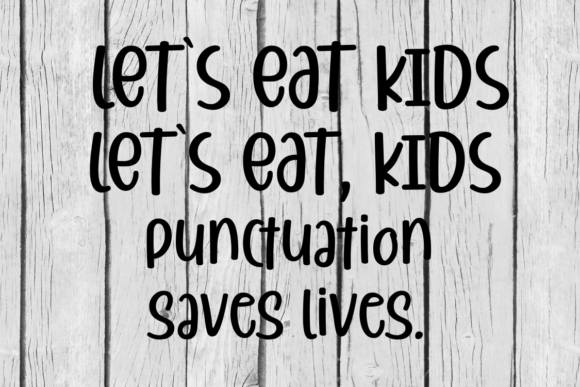
Funny Punctuation Quote SVG Cutting File for Graphics & Crafts
First Impression: Playful, Punchy, and Purposefully Pedantic
Opening the Funny Punctuation Quote SVG Cutting File, I immediately felt that familiar spark — the kind that says, “Yes, this has editorial legs.” It’s not just a craft file; it’s a tiny typographic provocation. The core message — Let’s eat kids. / Let’s eat, kids. / Punctuation saves lives. — lands with wit, warmth, and quiet authority. Visually, it leans into clean, bold letterforms with deliberate spacing and a smart comma placement that doubles as visual punctuation. It feels educational but never dry, clever but never smug — ideal for lifestyle blogs, grammar-focused educators, language podcasters, or small business branding with personality. This isn’t decorative filler. It’s a graphic design asset built to spark recognition, pause scrolling, and invite engagement.
Where It Earns Its Place in Real Publishing Workflows
In my own content publishing stack — from blog redesigns to digital product launches — the Funny Punctuation Quote SVG Cutting File slots in where clarity meets charm. I’ve used it as a hero image for a “Writing for Web Readers” guide, resized it for Pinterest pins driving traffic to grammar tool roundups, and embedded it into Canva templates for newsletter headers aimed at freelance editors. It works beautifully as an article thumbnail on category pages about communication skills, as a subtle accent in editorial layouts (think sidebar callouts or section dividers), and even as a playful watermark on downloadable worksheets about proofreading basics. Because it comes with both SVG and PNG formats, I can scale it crisply for responsive website headers, embed it cleanly in digital guides without pixelation, and repurpose it across social media graphics — especially Instagram carousels explaining micro-copy tweaks or LinkedIn posts about voice and tone.
Boosting Content Performance, One Comma at a Time
This isn’t just about aesthetics — it’s about performance. That single, well-placed comma transforms passive viewing into active interpretation. In practice, that means stronger first impressions: readers instantly grasp the theme and tone before reading a word. It sharpens visual hierarchy by anchoring attention to a clear, memorable idea. Click-through potential rises because it stands out amid generic stock imagery — especially on Pinterest, where text-driven, concept-led pins consistently outperform purely decorative ones. For affiliate marketing or content marketing campaigns around writing tools, grammar checkers, or creative software, this asset adds instant credibility and approachability. It also reinforces brand identity without shouting — consistent use across blog graphics, lead magnets, and media kits builds recognizable visual shorthand for “smart, human-centered communication.”
Best Places to Deploy This Graphic Design Asset
- Hero images for blog posts about editing, content strategy, or digital literacy
- Pinterest pins promoting free printables, grammar cheat sheets, or writing challenges
- Blog graphics illustrating “before/after” sentence revisions or style guide highlights
- Content upgrades like downloadable punctuation posters or classroom handouts
- Newsletter headers for weekly writing tips or editorial newsletters
- Social media previews teasing new articles on clarity, voice, or reader psychology
- Digital product covers for mini-courses on web writing or editing fundamentals
Where to Use It Thoughtfully — Not Everywhere
Like any strong editorial motif, this asset shines brightest when given room to breathe. Avoid cramming it into tiny mobile thumbnails where the comma vanishes and the message blurs. Steer clear of pairing it with text-heavy blog images — its power lies in simplicity, not competition. On low-contrast backgrounds (e.g., light gray text on off-white), test readability rigorously. In busy layouts — think layered patterns, overlapping elements, or dense photo collages — it risks visual noise. And while it elevates educational, creative, and lifestyle niches beautifully, reserve it for serious professional niches (e.g., legal compliance, financial reporting) only if your brand voice already embraces intentional levity. It’s not minimalism — it’s expressive minimalism — so it may clash with ultra-sparse, corporate visual systems.
Practical Publisher Notes You’ll Actually Use
Before deploying the Funny Punctuation Quote SVG Cutting File across your site or products, run these checks: preview it at actual desktop and mobile sizes; drop it into a live blog layout mockup beside real headlines; test contrast against your primary background colors; convert it to grayscale to confirm legibility; place it beside serif, sans serif, script, and display fonts to gauge typographic harmony. Since it’s delivered as a ZIP with SVG and PNG, verify that the SVG renders cleanly in modern browsers and that the PNG is compressed for web performance (under 150 KB ideal for social). Crucially: confirm the commercial license permits use on monetized websites, affiliate pages, and paid digital downloads — this is non-negotiable for bloggers, online educators, and creative entrepreneurs building sustainable content businesses. As a graphic design asset sourced from a trusted creative marketplace, it should support your small business branding without licensing risk.
Final Thought: More Than a Craft File — A Content Catalyst
What makes the Funny Punctuation Quote SVG Cutting File stand out isn’t just its Cricut-ready utility — it’s how effortlessly it bridges crafts and digital publishing. It turns a grammatical quirk into a shareable moment, a teaching point into a visual hook, and a printable design into a cross-platform brand signal. For anyone creating blog graphics, editorial design, or digital products with intention, this is a rare find: a lightweight, high-impact graphic design asset that performs quietly but memorably across every touchpoint — from website header to social media graphic to downloadable resource. It doesn’t shout. It winks — and leaves your audience smiling, thinking, and clicking.